Notions-Drye Goods Studio Diary

Thanks for checking in. I am a fiber artist. My current emphasis is on eco printing and other wildcraft with a touch of up-cycling thrown in. You can also catch up with me on Facebook at Drye Goods Studio.
Showing posts with label flowers. Show all posts

Sunday, May 17, 2026

Spring

When the arrowleaf balsamroot  is blooming spring is officially here!

I love looking in the pot and seeing the color start appear.

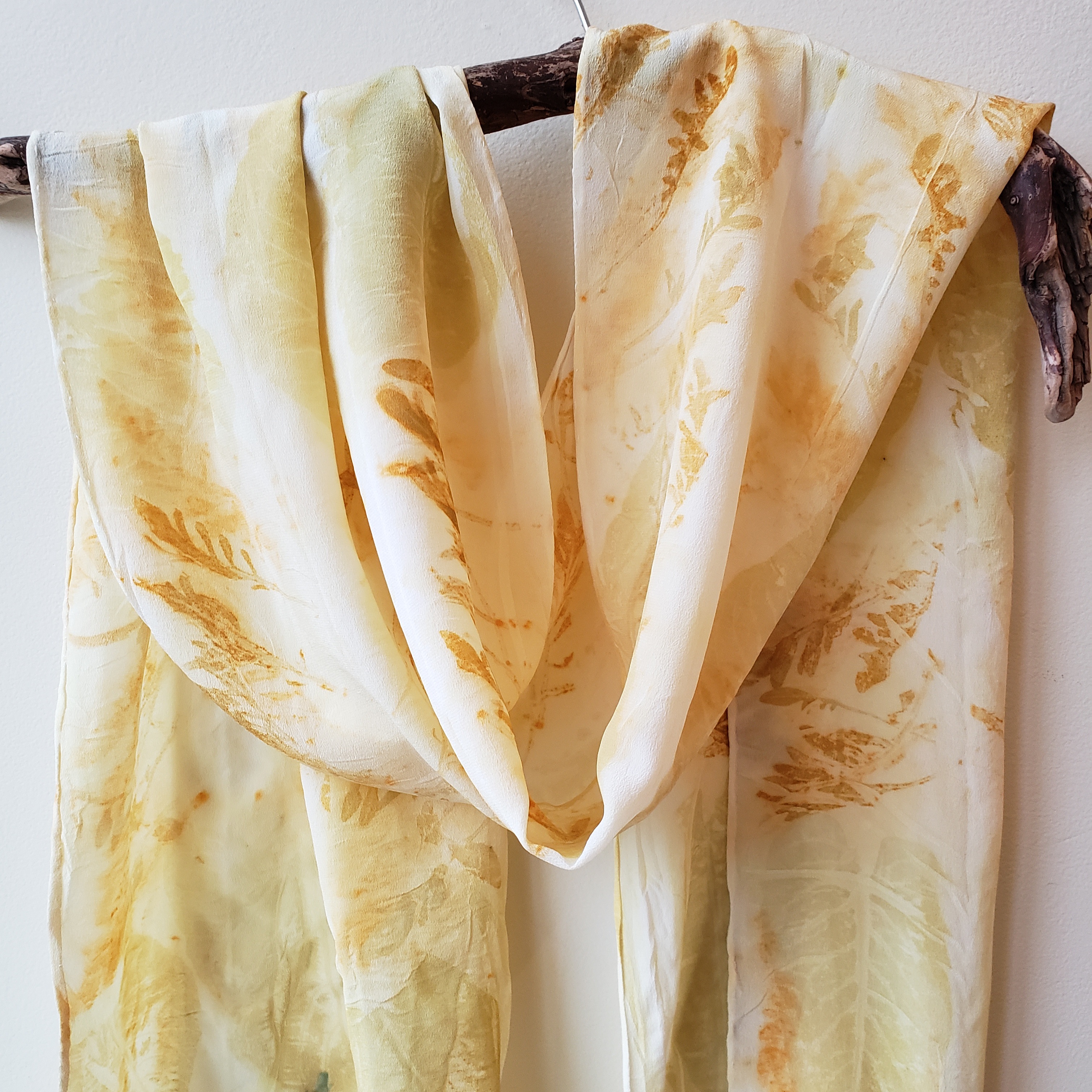
And this is what happened! The scarf pictured is made with arrowleaf balsamroot and spotted knapweed. This one is featured in my Etsy shop and several went to Pottery Place Plus.


Sunday, May 1, 2022

Happy May Day!


 The flower for May (at least in my world anyway) is Arrowleaf Balsamroot (Balsamorhiza sagittata). It is a member of Asteraceae or the sunflower family. It grows throughout the American west and is very prolific here in Eastern Washington. It just started to bloom and I have found that if I wait a few weeks the prints are much more vibrant and clear. And so we wait. I don't use the flowers (although sometime I should at least give it a whirl on paper), just the leaves. The scarf below was mordanted with alum and the print is anything from pale green to bright yellow. With an iron or rust pre-mordant it would come out olive green. It would also be possible to dip the yellow results in an iron post dip and achieve olive green also. As mentioned, the plant is very prolific here, but as with all plants in the wild, I approach harvesting with caution and common sense. I go where there is a lot of it and only pick one or two leaves off several plants over a large area; and harvest in a different area each time.


The pale green leaf down in the corner is the arrowleaf balsamroot, the bright orange is its malcontented neighbor spotted knapweed. 

Friday, January 1, 2021

New Year, New Day

 "Living in the past is depression, living in the future is anxiety."

Unknown


We have hit the gray and sometimes bleak part of winter here, so I decided to spend the week making a little sunshine. In the summer I pick Tansy flowers from along the river and hang them to dry for just such an occasion.

I put the dried flower heads in a pot of water to soak overnight, then simmered them for about 45 minutes to make the dye. The scent is lovely, like yarrow, sharp and calming at the same time.

This is right at the beginning, such a beautiful soft color! I simmered them for about an hour and then let them sit until evening before removing them from the dye bath.


The fabric in the background silk crepe de chine, the one swooshing across the middle is silk dupioni. These were scrappy type pieces of fabric that I had treated with alum last summer (I have no idea what I intended to do with them then) and they did have a bit of iron contamination as there are some spots here and there. No worries, I will either find something to do with them, or maybe, give them a bath in the iron pot and turn them olive green at a later date. Right now they are hanging in my studio so I can enjoy the color, which is about the color of the winter sun here when we get to see it.

At the moment, I am doing my best to live in the moment. Having too many expectations for the coming year could make it seem worse than it actually is. Looking back on the debacle of 2020, I can see where I did that to myself at times. I was just reading an article about people who are starting up whole new businesses during the pandemic, and I know several personally that started up businesses during the Great Recession that are still in business. While I have no interest in reinventing the wheel at this point, I am looking deeply (as I was right before the pandemic started) into the business side of my art, while still practicing art, no matter what type it is. I bought myself a little Christmas present, Shelley Rhodes book Sketchbook Explorations, and although I have never really kept sketchbooks decided it would be an interesting idea to mess around with while waiting for the snow to melt and spring to return. Only two days into it and I have had a bunch of thoughts about the art, that may or may not lead to other business ideas. But without the art, there is no business, so the thing to do is keep making more art and when the time is right (whenever in the world that might end up being) the business ideas tend to synthesize themselves.

If you can't seem to get into the "Happy New Year" mood, that may actually be a good thing for now. It may be your soul protecting you from either overthinking the past or the future; and thus causing you pain of one sort or another. About the only thing you have control over is today, so the things to do today are those that make tomorrow a better place, no matter what happens. 

Cheers, take care of yourself and stay safe.

Sunday, December 20, 2020

Merry Christmas

 "My dear

In the midst of strife, I found there was,

within me, an invincible love.

In the midst of tears, I found there was

within me, an invincible smile.

In the midst of chaos, I found there was

within me, an invincible calm.

In the depth of winter, I finally learned that

within me, there lay, an invincible summer. 

And, that makes me happy.

For it says, that no matter how hard

the world pushes against me, within me,

there's something stronger..."

Albert Camus

Poinsettia on watercolor paper treated with alum alone. Very Bright and zingy! The yellow is from the green leaves of the plant, the purples and greens from the red leaves of the plant.

Poinsettia on watercolor paper. Half the papers were treated with alum and half with a soak in iron water; then the papers were layered alternately so that both mordants effect the colors from the leaves. Some might say darker and more somber, but I think they are very interesting to look at.

A few years ago I did a post about poinsettia, such as its poisonous reputation etc., you can check that out here.

Have a wonderful holiday season, make the best of it any way you can while protecting yourself and those around you. Dig deep enough and you will find your invincible summer.


Saturday, April 25, 2020

Courage

"Sometimes courage does not always roar. Sometimes courage is the quiet voice at the end of the day saying, "I will try again tomorrow."
MA Radmacher

This scarf was done last year, with the two plants pictured below and PAS mordant.

Arrowleaf Balsamroot

Spotted Knapweed

Thursday, June 6, 2019

Invasive Species

"If we want fewer house sparrows and starlings, we do not need to kill them, we need to create an urban landscape in which a richer variety of species can thrive."
Lyanda Lynn Haupt, The Urban Bestiary

I thought about the above quote while I was out harvesting some knapweed the other day. She was talking about birds in urban areas, but the same theory holds true for plants in suburbs, farmland,and the margins like areas around train tracks and roads. Most of the reason this pesky plant survives is because we give it everything it needs to thrive. We want monocultures and grazing land at our disposal, but both of these create the perfect environment for knapweed of all kinds. 

Spotted knapweed is the most common around my neighborhood.  One recommended method to get rid of it over time is to keep mowing it and never let it bloom(this is not advisable for Russian knapweed to my understanding). This stresses the plant and eventually it dies. Since the seeds can be viable for up to ten years one could hose the area with pre emergent, creating an unbalanced situation where nothing can sprout, leaving more room for the knapweed to come up later once the pre emergent has lost its efficacy. Each plant produces 1,000 seeds, there is no way to know you have sprayed each and every one. Our local lupines, when encouraged to grow do beat knapweed to the punch as their roots contain oxalic acid which discourages the knapweed seed to sprout, while local grasses are unaffected and grow right alongside the lupine. A healthy balanced environment creates a situation where the knapweed can't grow.
I do my part by hacking it down and bringing it home and putting it in my steam pot. This scarf was pretreated with steel wool and printed with Arrowleaf Balsamroot (a native wildflower) and spotted knapweed. It is kind of a picture of Eastern Washington all on one piece of fabric.

Spotted knapweed makes a lovely yellow dye on protein fibers with an alum pre-mordant. Don't boil, just simmer. If I remember right I let the plant material soak in the water overnight first.

Here are both plants in all their glory. On silk with an alum pre-mordant. Remember that safety comes first, wear gloves to collect plants in the wild and always steam the fabric bundles outside.

"Spontaneous" plants (weeds) can be a lot of fun and as long as you don't do anything to make the situation worse nobody cares if you come to take them off their hands. 

Friday, December 28, 2018

Eco Printing from the Deep Freeze

I hope you had a lovely holiday! But it is time to get back to work. Trouble is, when everything is covered with snow and the plants are asleep, it can be a bit of a challenge to get anything done.


What with art fairs and then my husband's mishaps last summer I couldn't get to all the iris, so I froze them by taking the flowers apart and placing the petals between layers of wax paper and sliding the little packets into upcycled plastic zip bags from the kitchen. As you can see they start to bleed as they thaw, so it is advisable to wear gloves and work quickly. You could probably press and dry them, I haven't done this with iris, but I have with hollyhocks and the color is not quite the same. Freezing them gives a result more like fresh flowers. There always seems to be enough room in the freezer for our food and to tuck in a few flowers here and there. The fabric is silk crepe de chine with pre-applied rusty nails.


I also used some spiral eucalyptus from the florist and left over poinsettia leaves, both red and green. Iris petals don't print, but do dye the fabric


So with a little pre-planning it is possible to eco print when the weather outside is frightful.

Have a wonderfully prosperous New Year!

Thursday, November 8, 2018

The Color Red

I came across a writing prompt that said to pick a color and watch for it all day, then write about it. Since this is the season of commerce (places you can catch up with me are at the end of this post) and not much in the way of creating in the studio goes on, writing will have to do. I have to make something every day or I get crabby.

A woman was standing in my booth one time and ask me what was the hardest color to obtain. Since I don't really think about what I do in those terms, it kind of took me by surprise, but after a quick glance around I said "Well, if you take a look there isn't much in the way of red, in fact, no red at all." At that point I explained that while there were several options in natural dyes to obtain red, not many of them grow around here. For the most part I limit myself to what is available in the area, I figure I have already used up my carbon allotment by working on imported silk and then I also avoid dealing with the question of how a given dye stuff was harvested and shipped. Madder root, a traditional dye plant, is considered hardy to zone 5 so in the right position in the yard it would probably grow here, but it is a pretty big commitment. If it gets going it has to be in a raised bed as it can be invasive and it takes at least two years for the acid in the roots to be strong enough to make the dye, three to four years is better. Since actual whole cloth dyeing is not really my thing, it seems like a lot of work. We have its obnoxious little relative here, Lady's Bedstraw, that to my understanding will make some sort of a pink. Considering how invasive this naturally occurring plant is in the garden, you would think I would be all over it. Trying to find its roots however, is pretty challenging. They are very fine and you end up plowing up an entire garden plot just to finally get enough to work with. I decided it was just better to rip the plants off the top and dry them for a tea that is supposed to ward off kidney stones, a malady I hope I never get again, so I am willing to do about anything.  

Here is the red I saw in the last couple of days. Eastern Washington has entered the gray time of year. The sky is very often gray with fog, and unless there is snow, the ground gets gray and muddy as well. It gets dark early, Google informs me that sunset will be at 4:21 PM today. Red pops out.

Hawthorn leaf in a pile of cherry leaves

Hawthorn berries that will be picked off by the birds all winter

Mountain cranberries, also bird food.

As I was walking across the yard I thought I saw a bright red piece of fabric stuck in the border garden. It was this little rose bush putting out its last effort for the year! I was so surprised as we have had some really cold nights already, I guess it just had one more thing to say.
Anyway, you can catch up with me in at the following shows, and of course my work is always at Pottery Place Plus, 203 N Washington, Spokane, WA

Tonight I will have jewelry and scarves at The Inland Empire Gardeners' monthly meeting at Centerplace 2426 N Discovery Place, Spokane Valley WA. The market runs from 6-7 PM, meeting starts at 7:00

The Spokane Women's Club 5th Annual Artisans and Crafters Show, 1428 W 9th Ave. Spokane, Wa This Saturday 10-6 and Sunday 10-4

Custer's Christmas Arts and Crafts Show
Spokane Fair and Expo Center 404 N Havana St, Spokane Valley, WA
November 16th-18th Friday 10-8; Saturday 9-6; Sunday 10-4

Urban Art Cooperative's Holiday Market
3209 N Monroe, Spokane, WA
November 30th-December 2nd
Friday preview 6-9; Saturday 10-6; Sunday 10-4

Thursday, July 26, 2018

The Blues

"Particularly with the blues, it's not just about bad times. It's about healing the spirit."
Taj Mahal

Since I work with the seasons, sometimes it looks like I only work in one color. In this case, blue. Most of the blue you see here comes from Hollyhocks, although there is some petunia as well. Weirdly enough, I like ironing. In the studio, anyway. It gives me a chance to look things over and see wonderful details and surprises. Here is what I discovered today.

A little oak leaf hiding amongst the Hollyhock.

On the left, the main print (bottom of the leaf), on the right, the echo. I love the hollyhock on the left, almost photographic.

Sumac floating over rusted nails with a little bit of black locust for some green.

Another oak leaf, this one turned plum by its hollyhock neighbors.

Saturday, November 12, 2016

What a Week

This week has been very disconcerting. When I feel this way I look to nature to remind me of the bigger picture. I have taken a very long walk each day. I see the river rising as it should at this time of the year, the leaves changing and falling, and, thanks to the incredible amount of rain, the mushrooms rising. My husband has brought home something new almost every day to identify. There was even an article in our local paper about the diversity of fruiting fungi this fall, some not seen for the last ten years.  
                                                                                                                                                        Watching the ducks paddling around in swirling water that I would be afraid to swim in due to its force, is comforting as well as inspiring. They are completely at home no matter the tempest around them. Or, maybe to my untrained eye, they know when to dodge the churning water coming from below that I can't see from where I stand. I wish I had the same knowledge about my own world. To know how to swim into the whitewater while avoiding the deadly whirlpools would be empowering.


While my sunroom would hardly be considered a nature area, it is soothing to see my Christmas cactus doing what they normally do at this time of year. The days shorten and they bloom. With all the gray days in October, they are a bit ahead of schedule.  They have adjusted to what is going on around them. 
                                                                                                                                                         Outside is another story. Our temperatures this fall have been abnormally warm. We did have a light frost in September, so the hollyhocks and other perennials died back. The annuals died off and it looked like fall was on the way to winter. Then we had copious amounts of rain and highs in the sixties with nighttime lows in the high forties for all of October and now for the first two weeks of November. Today it is a beautiful spring day. We started out with rain and now it is sunny and breezy. Trouble is, it is not spring. The snapdragons and even some petunias have reseeded and sent up seedlings, the perennials are coming back from the roots. They don't know it yet, but all will get a rude awakening later in the week when it is supposed to freeze at night. 
                                                                                                                                                                  I feel like the outdoor plants. I had been going along thinking I had at least a notion of what was going on, and now-I don't know what to think or where to turn. Society was not what I thought it was. I went to bed one night and woke up to a very harsh reality. It would be easier to live in some sheltered, hothouse world where there was plenty of time to make decisions and adjust. Truth is, life is not that way. I stay grounded by enveloping myself in a world that remains constant by continuously changing, the real world, the natural world. The plants will freeze, go dormant and be back in the spring and their lives will go on. While I can't go dormant entirely (wish that I could) I do need to rest, pull back and conserve my energy for whatever life delivers next.


Tuesday, May 10, 2016

Weeds and Such

"Weeds are flowers too, once you get to know them."
A.A. Mine

Knapweed dye on silk


Thursday, January 14, 2016

Working with Dried Materials

When the snow is deep I work with what I have saved throughout the year. Drying and pressing is great as it doesn't take up space in the freezer and the materials last indefinitely. Not all dried flowers work (the darker the better) but in this case the hollyhocks are great fresh or dry. They got ahead of me last summer so I just picked up all the fallen blooms and left them in a basket to dry. I used them along with dried and pressed leaves on the last of my silk jacquard.


The stuff that looks like ash is the hollyhock, if you just throw them in whole they make kind of a blotch, so I am using them to color the background around the leaves. For these I used several kinds of maple, smoke tree, eucalyptus, onion skins and dogwood.


Rolls, both before and after steaming (the two darker ones are re-dos that went into the pot as well):


Some close ups of the results. I think it is interesting that the hollyhocks came out both a blue purple and a red purple. This probably had to do with the mordant (rusted nails) and how much was distributed on each piece. It could also be that the different leaves affect the color, acting as a co-mordant.


Sunday, January 10, 2016

So....How Poisonous is Too Poisonous?


Well, you would think that one would be easy to answer, wouldn't you?

First off, the obvious ones, poison ivy (Toxicodendron radicans and T. rybegii) and poison oak (Toxicodendron pubescens and T. diversilobum). At first I thought about searching the web over for copyright free images, but decided against it. Both plants have an eastern and western version in the United States and since they are wild plants they are greatly affected by their growing conditions. So  trying to identify them from a picture of an ideal specimen could lead to tragedy.  The poison in both plants is so long lasting it survives even in the dead fall leaves and in the smoke if it is burned. So, needless to say (you would think) you should not make steam prints or dye with it. For a mind blowing story about people who decided to try it out anyway,  check out India Flint's blog post  about such things-YIKES! I have discovered here in Eastern Washington poison ivy seems to like to grow at the feet of Oregon Grape, why I wouldn't know, but it does. So, if I am picking up windfall leaves, I avoid raking anything out from under an Oregon Grape as Oregon Grape leaves don't work anyway and who knows what else might be lurking around under there. Last summer in Northern California I finally saw poison oak for the first time and it also likes to grow up, in and around other plants.

Fact is, every area of the country has poisonous plants both wild and in our gardens. It is really important that you know what they are. Knowing the scientific names helps, check out the ones above-"toxic" should give you a clue! Any name ending in Tinctoria or Tinctorium indicates a dye plant, but not necessarily that it is harmless.

 If you are the type of person that breaks out into hives just riding the lawn mower, this may not be the hobby for you. Many plants that do make color also have active ingredients that can give them medicinal properties, so anything that can help you can hurt you. Tansy, for instance makes yellow and green dye. It has been used as a medicinal tea but should only be used under the supervision of a trained herbalist as if consumed in large quantities it can cause convulsions and psychotic effects and is poisonous to grazing livestock and can poison the milk production from those animals. Rhubarb leaves contain oxalic acid, used both as a mordant and a cleaning agent, but is lethal to consume. Things like oleander, foxglove, hemlock and anemones are so poisonous they, like poison ivy and oak, should be avoided altogether. It is possible that what one person has a bad reaction to, another will not. A friend of mine was clearing scotch broom (also a known dye plant) from her yard and suffered anaphylaxis, making it to the emergency room just in time. She told me this after I had a bunch boiling away in a bundle; no harm seemed to come to me from it, however I think I will be more careful in the future-especially since the result from the steamed leaves was underwhelming.

The best advice I can offer is that if you are not an expert at plant identification it might be advisable to go on guided nature walks or take classes if possible. Park services, county extension services, garden clubs and other outdoor activities groups offer such things and they can be really informative as well as fun. Having a local park ranger point out what poison ivy looks like in your area is much more memorable than a picture. That being said having an actual guide book for your area along on a collecting trip can help you avoid danger. There are also weed apps for phones, but if you are out far enough, there may be no signal in order to be able to use it.  That, and not everything that is dangerous is considered a "weed". Old school is best in some cases. 

Using common sense when processing plants is invaluable. Wearing gloves while working with things you are unfamiliar with, keeping a dedicated set of tools for dyeing and doing all your cooking outside are good for a start. Remember that in some cases, nobody ever thought anybody would be cooking a particular plant to begin with, so no one knows what might be in the fumes, just make the assumption there might be something poisonous in the vapor and don't breath it in. The mordants you use can have issues as well, sometimes more so than the plants; wearing gloves can protect you from a lot of strife. Even things that are food stuffs can be problematic, my "roommate for life" has requested that I never cook cabbage for over an hour in the house ever again-he was coughing his brains out. After having to deal with cabbage scented sheets, curtains, rugs and blankets, it is a request I have no trouble complying with!

The long and short of it is, don't get a false sense of security from the words "natural" and "organic" there are plenty of naturally occurring dangerous organic substances in the world, it is up to us to use common sense in order to avoid trouble.

Wednesday, November 25, 2015

Monkshood

Time for another plant with a creepy sounding name from days of yore. I tend to buy plants off the "half dead" table at the local home center, so the labels are usually gone. What ever this thing was, the plant itself looked like a delphinium, but the flowers were different and it bloomed in the late fall. A couple of weeks ago it was the only thing left blooming out there, so I decided to throw the last of it into a scarf and see what happened.


While it was cooking away I plopped myself down in front of Google to see if I could figure out what it was. After not too much surfing, I discovered it was Monkshood. It is poisonous (of course) and thus the deer don't like it (good enough reason for it to stay in the yard) and it blooms in the late summer and fall which is also a selling feature for me. By the time we get to late summer everything else is cooked in the heat.


I used a smallish piece of silk crepe de chine with steel wool as the pre-mordant. The flowers did impart the smoky, blue/purple to the back ground, I suppose if I used enough of them it would dye the whole background that color, which could be nice. I did throw some of the leaves into other samples, but nothing came of it. At any rate, it was a nice experiment for the last blooming plant in my garden. Now there is a layer of snow out there and everything has gone to sleep for a long winter's nap. 

Wednesday, July 8, 2015

Happy Turkey Day!


Today was International Happy Turkey Day at our house. Never heard of it? Neither had I. Turns out, this day is celebrated on the first Wednesday after the 4th of July. Mama turkey arrives in your yard the day before you are supposed to leave for a show in California. I guess tradition holds that once she and her babies arrive, all productive work ceases. Pots boil dry on the stove, laundry molds in the washer etc. This is so that you and any other humans around the place can stand on the deck, or behind trees or sneak around the bird bath to try to observe the turkeys, well, being turkeys. Part of the tradition is also trying to count the number of babies (4) while burning up your phone battery taking grainy motion shots of Mom turkey and her wee ones diving in and out of the perennial border. Turkeys are apparently very camera shy. I ended up way behind on the watering schedule for the yard, as I really didn't want to turn the sprinklers on the baby turkeys. They left, I turned on the sprinklers, and here they were back again! As hot as it is, it is no wonder. I felt like scratching a dip in the ground and sitting in the spray myself.

Later on I went to water flower pots in the front yard and they were out there, heading off to neighbor Neal's to have a bit of chicken scratch before bed I suppose. I can't imagine what Neal's domestic girls think of their wild cousins inviting themselves to dinner.

The best surprise was the gift I received tonight. I went out to the garden to get squash and onions for our dinner, and discovered mom turkey had left a small feather.  The most startling thing about a wild turkey is how big they are, not their coloring. But this feather has the most beautiful subtle shades of grays, browns and tans with small bits of olive green thrown in. I wish I could draw it, but this photo will have to do.

Well, ready or not, I am off to California to visit friends, see galleries and then do the show at Mendocino the 18th and 19th-hope to see you there!

Tuesday, May 12, 2015

Books About Eco Printing


I like lists, so here is a list of books that I have found useful for learning eco printing.

1. Eco Colour by India Flint; 2008, Interweave Press.                                                                                    This book changed my life. While causing me to grow as an artisan and craftsperson, it also brought me full circle to a place and time where I was a lot more comfortable in my own skin. It is not an instruction book or recipe book per se, so if you know nothing about natural dyeing, it could be a bit confusing-or the perfect place to start. To have somebody tell me I didn't need to order exotic dye stuffs and that using what I had thought of as toxic mordents was completely unnecessary was exhilarating. It threw out all the notions I had about natural dyeing and opened a whole new world for me.

      Some of it is hilarious, the part where she talks about the pros and cons of using cat urine as an adjunct cracks me up. Since I haven't known any cats willing to pee in a cup, I wondered how in the world she got enough to experiment with!

     The text is accompanied by lovely photography, making it a beautiful object in and of itself, a place where dreams can grow.

2. Harvesting the Color by Rebecca Burgess; 2011, Artisan.
     The author leads you through the seasons while guiding you to plants that for the most part are found or can be grown in North America. The book is geared towards those that work with wool roving (as most seem to be) but much of it can be used or adjusted for dying natural fiber fabrics. It did make me want to travel the country to try out many of the plants she uses. She also uses ecologically responsible mordants etc. This IS a recipe book for those that must have one to follow, but it is not about eco printing-the dye stuffs and mordants she uses are very helpful however.

3. Wild Color by Jenny Dean; 1999 and 2010, Watson-Guptill Publications
     This is a great technique and recipe book with a bit of history and back ground thrown in. Many of the dye materials are plants found in North America and she gives good little color swatches along each page with the plant. Again, not about eco printing, but playing around with the pre-mordants and modifiers in a eco print setting can be loads of fun!

4. A Dyer's Garden by Rita Buchanan; 1995, Interweave Press
     This is a great guide for growing your own dye plants. She gives a lot of information about the plants themselves and color swatches down the side of each page. She also has a helpful section on what not to grow yourself and why.

5. Craft of the Dyer by Karen Leigh Casselman; 1983, 1993, Dover
     I found this book used and almost passed on it and now I am glad I bought it. While she does use mordants I would not use (I tend to convert things like that into "pot as mordant" in one fashion or another) it is a fantastic list of plants, both wild and from the garden with great commentary about extracting color from them. No photos, but she does give the scientific name for each plant so you can do a quick search to see what it looks like.

6. Plant Guides
     I am a geek about plant guides-I have tons of them. I really like the ones from Lone Pine press as they have good images and descriptions and a notes section that tells you all sorts of weird fun facts about the plants, including whether anybody used them for color or not. I also own weed, tree and wild flower guides for the Inland and Pacific Northwest. All of which live mostly on the back seat of my car to be used when needed. Many state and county weed boards have come up with weed ID apps, which are great if you have a cell signal, not terribly useful if you don't. Low tech as it may be, books on the back seat very often work out the best!

     Please note, I did not provide links to purchase these books on line on purpose. It would really help out your local independent bookseller if you went to them first. No local independent bookseller left in your area? Then at least go to the local version of the big box bookstore and buy them there-the folks in your town that work there need their jobs and the way they get to keep them is if big companies know that a real book store is important enough for you to shop there. Thanks!


Friday, October 24, 2014

Goodbye to Green for this Year!

Summer is finally coming to a close here in Eastern Washington. I used almost dead sunflower leaves on silk that had been wrapped around a copper pipe to get the greens pictured here. I have time to make some more, just waiting for the copper pipe to work it's magic on the silk.